
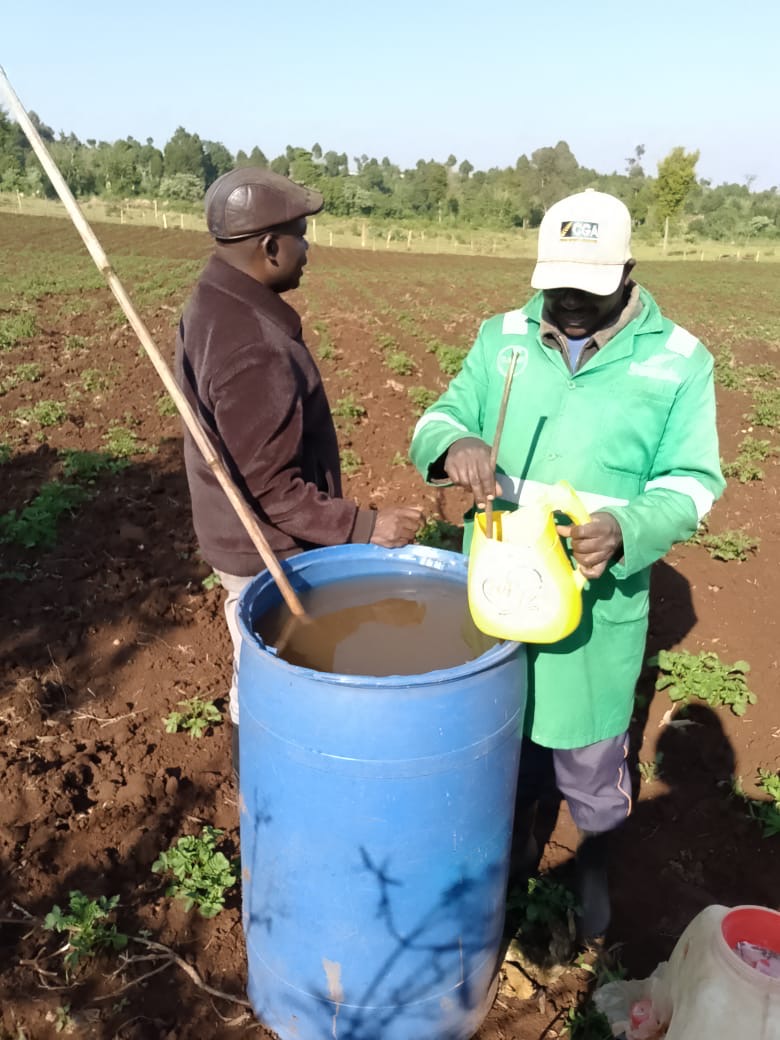
Jambo, farmers. Do not prepare every part of the field in the same way just because planting is close. Walk the land first. A hard layer, a sealed surface, a dry ridge and a low spot holding water are different problems. Your soil preparation should respond to what you actually find, while protecting the structure and organic matter that already work for you.
Walk your field before planting and check compaction, crusting, organic matter, infiltration and drainage before you decide what soil preparation is needed.
Buy HumiBakt for 1 acre →Walk the field with a spade before the tractor starts
Choose several representative points: a productive area, a weak area, a wheel track, a slope and a low spot. Look at the surface and then open the soil. Record crusting, standing water, cracks, shallow roots, hard layers, residue breakdown and differences in colour or smell.
Soil health is not one number. Physical indicators such as infiltration, structure and compaction should be considered together with organic matter, biological activity and a soil test where available. Compare points within the same soil type and record the location so you can return after planting.
Source: HumiBakt Africa French bean field archive (Kenyan field material; not a controlled trial)
Protect pores that carry both water and air
Good soil structure contains connected pores. Some hold useful moisture; larger pores allow water to enter, excess water to drain and air to reach roots. Compaction presses particles together and can restrict infiltration, drainage and root growth.
Do not cultivate simply to make the surface look fine. Match the operation and depth to a diagnosed problem. Avoid unnecessary traffic on wet soil, control machinery routes where practical and do not repeatedly disturb a layer that is already open.
Keep useful organic matter working in the field
Suitable crop residues and mature organic inputs feed soil organisms, protect the surface and support aggregation. They are part of a long-term system; one quick cultivation cannot rebuild organic matter that has been lost over years.
Check whether residues are breaking down and whether the surface is covered or bare. Match residue decisions to the crop, pest and disease plan. Do not bury infected material simply because organic matter is valuable.
Follow where water enters, runs and remains
After rain or irrigation, inspect where water ponds, runs off or disappears quickly. Check low spots, compacted headlands and eroded slopes. Safe drainage may be needed in one area while another needs more cover and improved infiltration.
Use the latest Kenya Meteorological Department guidance for your location and make the final timing decision from local conditions. County, sub-county, soil texture and irrigation access all matter; one national planting date does not fit every field.
Source: IUNG-PIB: Assessment of the agricultural usefulness of HUMIBAKT, field trial report, April 2025 (Polish research file supplied by HumiBakt Africa)
Use this order before planting
1. Map the different field zones and record the crop, acreage and intended planting window.
2. Walk and dig at several points. Mark compaction, crusting, ponding, fast-drying soil and erosion.
3. Take representative soil samples when testing is part of your plan, then choose the necessary correction, fertility programme and seedbed work.
4. Protect suitable residues or add appropriate mature organic material. Prepare drainage and traffic routes before machinery spreads the problem.
5. Confirm seed, inputs, water, labour and delivery dates. Prepare the soil only when its moisture condition is suitable for the operation.
Place HumiBakt inside the soil preparation plan
HumiBakt supports the biological and humic part of the root-zone plan. For soil application, the current guidance is 80 g mixed with 80 litres of clean water per acre, applied evenly to suitably moist soil according to the current pack instructions. The water carries the product; it does not replace irrigation.
Schedule the application before sowing or transplanting so the product reaches the future root zone. Keep HumiBakt out of the same tank as synthetic crop-protection chemicals. It does not replace drainage, correction of serious compaction, quality seed, crop nutrition or good field hygiene.
Take this field checklist with you
Field and location: ____ | Crop and acres: ____ | Previous crop: ____ | Intended planting window: ____
Surface cover and residue breakdown: ____ | Crusting: ____ | Hard layer or wheel-track compaction: ____
Ponding, runoff or erosion: ____ | Fast-drying zones: ____ | Drainage work: ____ | Soil sample or advice needed: ____
Preparation required in each zone: ____ | HumiBakt application date: ____ | Water, equipment and person responsible: ____
Photograph the marked points before work begins. Keep one fair comparison area and return to the same places after emergence.
Discuss the timing before the seed goes in
Share your crop, county or sub-county, acreage and expected planting date with your local Farmer Service Centre. Explain what you found during the field walk. Your FSC can help you discuss the soil preparation and confirm HumiBakt application timing and supply.
The best time to find a soil problem is before planting, when the plan can still be changed.
Questions from farmers
Should I cultivate every field deeply before planting?
No. First identify the problem and its depth. Match cultivation to the soil, crop and diagnosed restriction, and avoid unnecessary disturbance or traffic on wet soil.
Does adding organic matter solve compaction immediately?
No. Organic matter supports structure over time, but a severe compacted layer may need a specific correction. Diagnose the layer and use local agronomic advice.
Can HumiBakt replace drainage or irrigation?
No. HumiBakt supports the soil biological and humic environment. Drainage and crop water still need their own field plan.
When should I apply HumiBakt?
For the pre-plant soil programme, schedule it before sowing or transplanting and follow the current pack instructions. Discuss local timing with your FSC.
Prepare your soil now
Start the crop with living soil
Put HumiBakt’s humic substances and beneficial Bacillus bacteria into the root zone before planting. HumiBakt costs KES 3,500 per acre, including 16% VAT. Order online now or buy with guidance from your local FSC.
Sources & further reading
Research findings are reported with their limits. Product information, field observations and controlled results are kept separate.
- HumiBakt Africa: product and application guide
- USDA NRCS: Soil Health on Cropland
- HumiBakt KEPHIS registration dossier and technical documentation (internal product file)
- IUNG-PIB: Assessment of the agricultural usefulness of HUMIBAKT, field trial report, April 2025 (Polish research file supplied by HumiBakt Africa)
- HumiBakt Africa French bean field archive (Kenyan field material; not a controlled trial)
- HumiBakt Africa: current Kenya product offer and commercial guarantee, updated September 2026 (internal offer file)
- Kenya Meteorological Department: local forecasts and agrometeorological guidance
- USDA NRCS: Soil Health Assessment
- KALRO: Potato Technologies, Innovations and Management Practices
- KEPHIS: Seed Certification Resources