
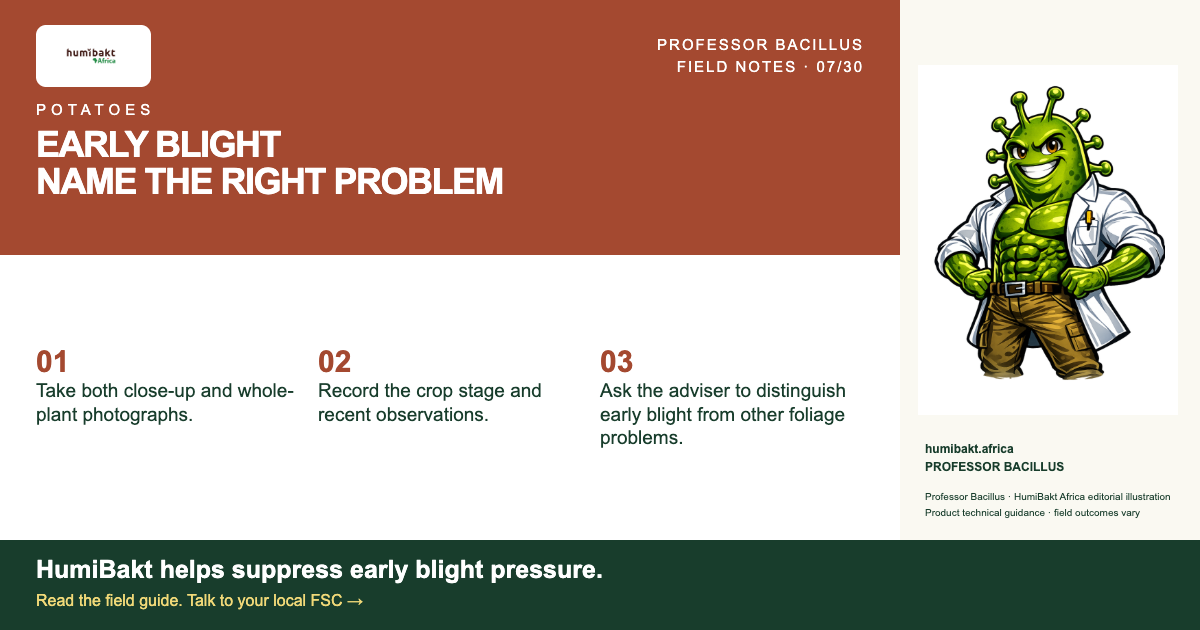
A farmer who reports “blight” may be describing several different problems. Early blight and late blight are not two stages of the same disease. Naming the right problem is the first step towards a useful conversation about the crop and its management.
“Blight” is not a complete diagnosis for your potatoes. A practical potatoes guide from HumiBakt Africa.
Buy HumiBakt for 1 acre →What to look at in your field
Early blight is associated with Alternaria solani. Target-like rings can develop in leaf lesions, but a photograph should be assessed alongside the crop’s condition and history. Late blight involves a different organism and should not be inferred from the word “blight” alone.
At the next field visit, label images as observations until the cause has been assessed. Record the leaves affected, the field position and any change since the previous visit. This keeps the conversation grounded in what the crop actually shows.
Three actions for your next field discussion
1. Take both close-up and whole-plant photographs.
2. Record the crop stage and recent observations.
3. Ask the adviser to distinguish early blight from other foliage problems.
Where HumiBakt fits
HumiBakt helps suppress early blight pressure. Its beneficial microorganisms compete with undesirable microorganisms and support the plant’s natural defence mechanisms.
This disease-specific statement comes from HumiBakt’s Zambia seed-material technical document, page 2. It is product technical information, not a mapped Kenya field trial or a guarantee of the result on your farm.
HumiBakt is a microbiological soil fertiliser, not a plant protection product. Follow the current pack instructions and use it within a locally appropriate crop programme. Outcomes depend on the crop, field conditions and application.
Source: HumiBakt disease register and Zambia seed-material technical document, page 2: product technical source, not a mapped formal crop trial
Turn the observation into a crop plan
Send your county, acreage and planting date to your local FSC. Bring the field observations described here so you can discuss a practical potatoes programme.
Questions from farmers
Is early blight an early stage of late blight?
No. They are different diseases associated with different organisms.
How can my FSC help me plan the next step?
Send your county, acreage and planting date to your local FSC. Bring the field observations described here so you can discuss a practical potatoes programme.
Prepare your soil now
Start the crop with living soil
Put HumiBakt’s humic substances and beneficial Bacillus bacteria into the root zone before planting. HumiBakt costs KES 3,500 per acre, including 16% VAT. Order online now or buy with guidance from your local FSC.
Sources & further reading
Research findings are reported with their limits. Product information, field observations and controlled results are kept separate.
- University of Minnesota Extension: early blight in tomato and potato — general disease background; not evidence of HumiBakt efficacy
- HumiBakt disease register and Zambia seed-material technical document, page 2: product technical source, not a mapped formal crop trial
- HumiBakt Africa: product application guidance
- Before Planting Potatoes: Plan Your Soil, Seed and Crop Budget