
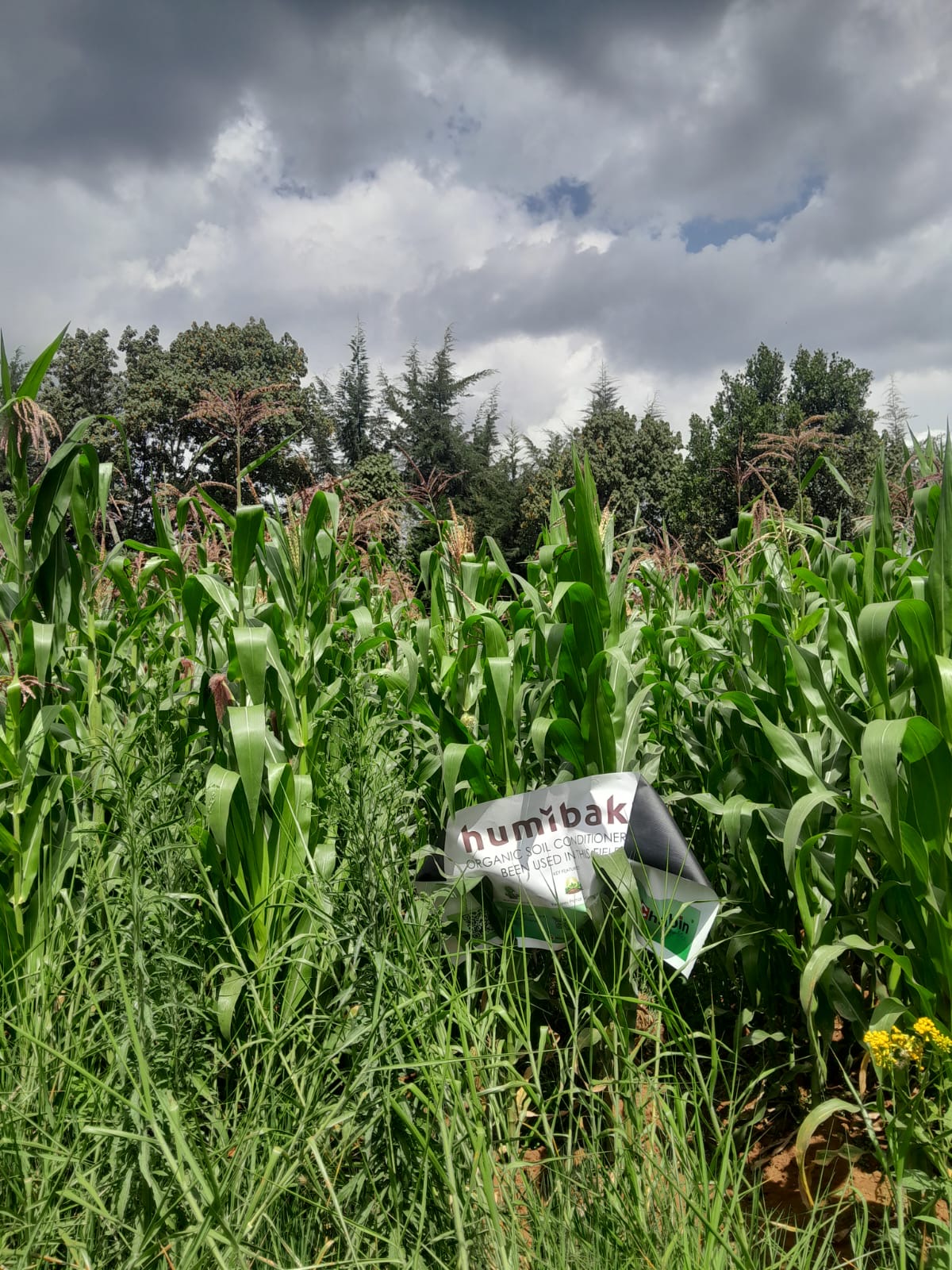
Jambo, farmers. If the treated area gets better seed, more fertiliser or a better part of the field, the comparison cannot answer whether HumiBakt made the difference. Build the test before planting. Choose comparable areas, keep management equal, write down what will be measured and agree on the review date while the field can still be marked clearly.
Choose comparable treated and untreated areas before application, record every input and agree how emergence, marketable yield and profit per acre will be measured.
Buy HumiBakt for 1 acre →Choose one decision the comparison must answer
Write the question in one sentence. For example: under the same maize programme, does adding HumiBakt improve marketable yield and profit per acre? A potato or French bean grower can use the same structure with crop-appropriate measures.
Do not change HumiBakt, seed, fertiliser rate, irrigation and planting date at the same time. When several things change, you cannot tell which change caused the result.
Choose comparable areas before application
Use representative parts of the same field or closely matched blocks. Avoid putting the HumiBakt treatment on the best corner and the comparison on a compacted, shaded or waterlogged corner. Record slope, soil type, previous crop and visible differences.
For a commercial farm, repeated strips across field variation are stronger than one treated block beside one comparison block. If repetition is not practical, record the limitation and avoid turning one observation into a universal claim.
Source: HumiBakt Africa French bean field archive (Kenyan field material; not a controlled trial)
Mark the boundary so the comparison survives the season
Measure each area and mark corners with durable pegs, paint or GPS coordinates. Draw a simple field map. Give the treated and comparison areas clear names that the field team will use.
Take baseline photographs from fixed points before soil preparation or application. Photograph both areas from the same angle and distance. A photograph supports the record; it does not replace counts and weights.
Keep every other operation as equal as practical
Use the same crop, variety, seed lot, planting date, spacing, fertiliser, crop protection, water and field operations. Record unavoidable differences immediately instead of correcting the story at harvest.
Brief the tractor, sprayer, irrigation and harvest teams. A comparison can be lost when one operator crosses the marked boundary or when produce from both areas is mixed.
Record the HumiBakt application exactly
For the pre-plant soil programme, the current guidance is 80 g HumiBakt in 80 litres of clean water per acre, applied evenly to suitably moist soil according to the pack instructions. Record the date, product quantity, water volume, treated acreage, soil condition, equipment and operator.
The mixing water is a carrier, not irrigation. Keep HumiBakt out of the same tank as synthetic crop-protection chemicals. The comparison still needs the normal seed, nutrition, drainage, irrigation and crop-protection programme.
Agree on measures and review dates now
Choose crop-appropriate dates for emergence counts, uniformity checks and root observations. Use several fixed sampling points in each area. Early appearance can guide management, but it is not the final yield or profit result.
At harvest, measure the same known area. Weigh total and marketable produce separately, record rejects and quality, and keep selling price visible. For repeated harvests such as French beans, record every pick from both areas.
Calculate the result per acre
Record HumiBakt, application labour, water, equipment, extra harvesting, grading, packaging, transport and selling costs. Compare these with any additional revenue from marketable yield and only those savings that were actually documented.
Change in profit per acre = additional revenue from marketable yield + documented savings − HumiBakt and all additional costs. Do not use a guaranteed selling price or an assumed yield increase in the final result.
Copy this comparison sheet
Crop, field and county: ____ | Variety and seed lot: ____ | Planting date: ____ | Treated acres: ____ | Comparison acres: ____
Map or GPS points: ____ | Previous crop and field differences: ____ | Baseline photos: ____
HumiBakt date, rate, water, soil condition and operator: ____ | Fertiliser, crop protection and water programme: ____
Emergence count dates: ____ | Root and uniformity checks: ____ | Harvest dates: ____
Treated total and marketable yield: ____ | Comparison total and marketable yield: ____ | Rejects: ____
All additional costs: ____ | Selling price: ____ | Change in profit per acre: ____ | Review date and people present: ____
Review the evidence with the people who made the decision
Agree before planting who will review the result: the farmer, farm manager, FSC or HumiBakt team. Keep disappointing results and operational mistakes in the record. They can improve the next application and prevent a weak comparison from becoming a sales claim.
Share your crop, county or sub-county, acreage and planting date with your FSC or our team. Agree on the comparison area and review date before the product reaches the field.
Questions from farmers
Do I need an untreated comparison area?
A fair area without HumiBakt provides the clearest local reference when all other management is kept as equal as practical.
How large should the comparison be?
There is no universal size. It must be large enough to represent normal field variation and to harvest separately. Commercial farms should use repeated strips where practical.
Can photos prove the result?
Photos are useful records, but they do not replace plant counts, measured marketable yield, quality, costs and a clearly marked comparison.
What should remain the same?
Keep crop, variety, seed lot, planting date, spacing, fertiliser, crop protection, water and field operations as similar as practical. Record every unavoidable difference.
Prepare your soil now
Start the crop with living soil
Put HumiBakt’s humic substances and beneficial Bacillus bacteria into the root zone before planting. HumiBakt costs KES 3,500 per acre, including 16% VAT. Order online now or buy with guidance from your local FSC.
Sources & further reading
Research findings are reported with their limits. Product information, field observations and controlled results are kept separate.
- HumiBakt Africa: product and application guide
- USDA NRCS: Soil Health on Cropland
- HumiBakt KEPHIS registration dossier and technical documentation (internal product file)
- IUNG-PIB: Assessment of the agricultural usefulness of HUMIBAKT, field trial report, April 2025 (Polish research file supplied by HumiBakt Africa)
- HumiBakt Africa French bean field archive (Kenyan field material; not a controlled trial)
- HumiBakt Africa: current Kenya product offer and commercial guarantee, updated September 2026 (internal offer file)
- Kenya Meteorological Department: local forecasts and agrometeorological guidance
- USDA NRCS: Soil Health Assessment
- KALRO: Potato Technologies, Innovations and Management Practices
- KEPHIS: Seed Certification Resources