
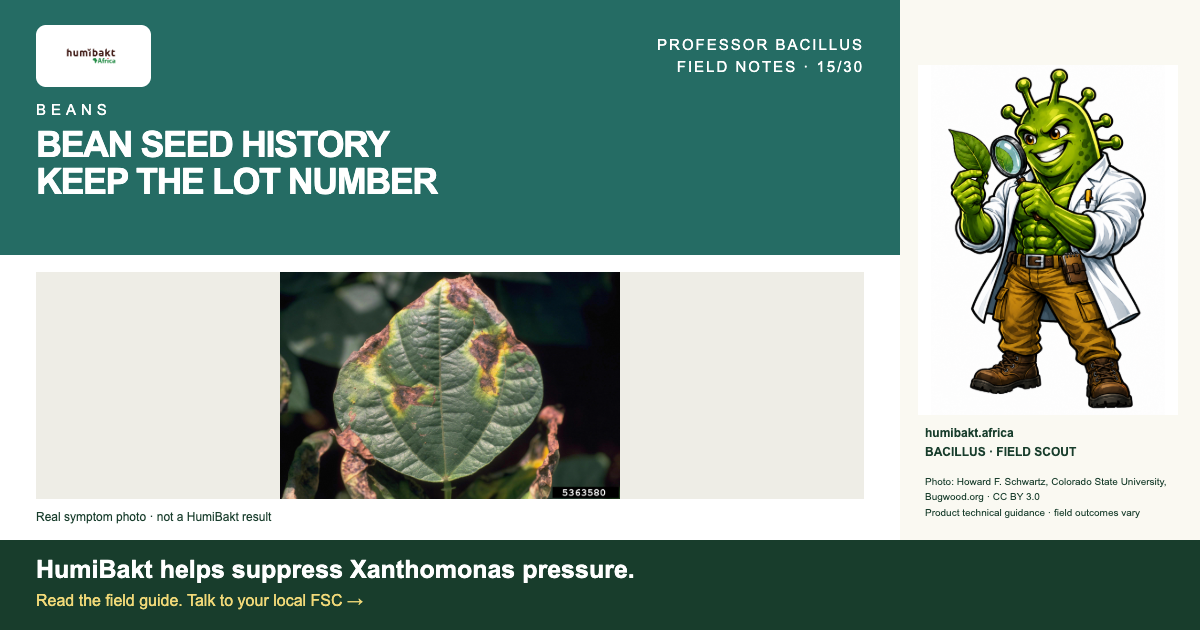
When leaf symptoms appear, farmers often remember the variety but not the seed lot. Recording that detail takes little time before sowing and can be valuable later. For a Xanthomonas discussion, connect the crop’s seed history with what is happening in the field.
Keep the seed label. It may be the most useful part of your next bean-field discussion. A practical beans guide from HumiBakt Africa.
Buy HumiBakt for 1 acre →Make the record useful
Use a notebook or phone folder with one entry per field. Record supplier, variety, lot, sowing date and acreage. Add each observation without replacing the original information. If several seed lots are used, show where each one was planted.
A shared lot does not itself prove the source of a disease. Its value is traceability: an adviser can compare patterns and decide what further information is needed. Keep that distinction clear when discussing the issue with the supplier or neighbouring farmers.
Three actions for your next field discussion
1. Photograph seed packaging and retain purchase details.
2. Map lots to fields or clearly marked blocks.
3. Add the first symptom date and professional diagnosis when available.
Where HumiBakt fits
HumiBakt helps suppress Xanthomonas pressure. Its beneficial microorganisms compete with undesirable microorganisms and support the plant’s natural defence mechanisms.
This disease-specific statement comes from HumiBakt’s Zambia seed-material technical document, page 2. It is product technical information, not a mapped Kenya field trial or a guarantee of the result on your farm.
HumiBakt is a microbiological soil fertiliser, not a plant protection product. Follow the current pack instructions and use it within a locally appropriate crop programme. Outcomes depend on the crop, field conditions and application.
Source: HumiBakt disease register and Zambia seed-material technical document, page 2: product technical source, not a mapped formal crop trial
Turn the observation into a crop plan
Send your bean crop type, county, acreage and planting date to your local FSC. Bring the field observations described here so you can discuss a practical beans programme.
Questions from farmers
Does a seed-lot record prove where Xanthomonas came from?
No. It supports investigation; determining the source needs additional evidence.
How can my FSC help me plan the next step?
Send your bean crop type, county, acreage and planting date to your local FSC. Bring the field observations described here so you can discuss a practical beans programme.
Prepare your soil now
Start the crop with living soil
Put HumiBakt’s humic substances and beneficial Bacillus bacteria into the root zone before planting. HumiBakt costs KES 3,500 per acre, including 16% VAT. Order online now or buy with guidance from your local FSC.
Sources & further reading
Research findings are reported with their limits. Product information, field observations and controlled results are kept separate.
- University of California IPM: common bacterial blight of beans — general disease background; not evidence of HumiBakt efficacy
- HumiBakt disease register and Zambia seed-material technical document, page 2: product technical source, not a mapped formal crop trial
- HumiBakt Africa: product application guidance
- French Beans: Prepare the Seedbed and Plan for Marketable Yield
- Photo: Howard F. Schwartz, Colorado State University, Bugwood.org · CC BY 3.0 — symptom reference photograph
- Photograph licence (unchanged image)
