
A gap in a maize row invites a quick explanation, but missing or weak plants can have several causes. A field visit should bring together planting depth, seed information, soil condition and plant observations before assigning the problem to a pathogen.
Uneven maize emergence? Look at the seedbed and roots as well as the leaves. A practical maize guide from HumiBakt Africa.
Buy HumiBakt for 1 acre →What to look at in your field
Rhizoctonia solani is included for maize in HumiBakt’s technical disease register. That does not make every uneven stand a Rhizoctonia case. Examine representative weak and stronger areas with an adviser and record what is seen below the surface as well as above it.
Compare places with similar planting dates and management. A wet low point and a freely drained part of the field are not automatically a fair product comparison. Mark differences in field conditions so they remain visible when you discuss results later.
Three actions for your next field discussion
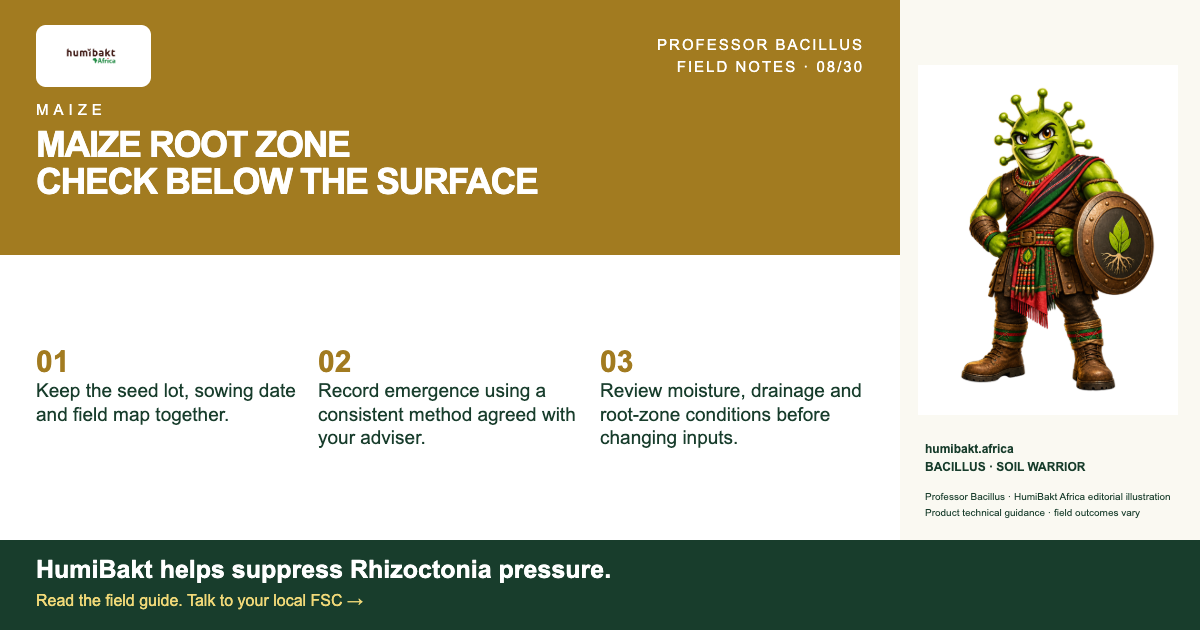
1. Keep the seed lot, sowing date and field map together.
2. Record emergence using a consistent method agreed with your adviser.
3. Review moisture, drainage and root-zone conditions before changing inputs.
Where HumiBakt fits
HumiBakt helps suppress Rhizoctonia pressure. Its beneficial microorganisms compete with undesirable microorganisms and support the plant’s natural defence mechanisms.
This disease-specific statement comes from HumiBakt’s Zambia seed-material technical document, page 2. It is product technical information, not a mapped Kenya field trial or a guarantee of the result on your farm.
HumiBakt is a microbiological soil fertiliser, not a plant protection product. Follow the current pack instructions and use it within a locally appropriate crop programme. Outcomes depend on the crop, field conditions and application.
Source: HumiBakt disease register and Zambia seed-material technical document, page 2: product technical source, not a mapped formal crop trial
Turn the observation into a crop plan
Send your county, acreage and planting date to your local FSC. Bring the field observations described here so you can discuss a practical maize programme.
Questions from farmers
Does uneven emergence prove Rhizoctonia?
No. Seed, soil, moisture, planting and other problems can also affect establishment.
How can my FSC help me plan the next step?
Send your county, acreage and planting date to your local FSC. Bring the field observations described here so you can discuss a practical maize programme.
Prepare your soil now
Start the crop with living soil
Put HumiBakt’s humic substances and beneficial Bacillus bacteria into the root zone before planting. HumiBakt costs KES 3,500 per acre, including 16% VAT. Order online now or buy with guidance from your local FSC.
Sources & further reading
Research findings are reported with their limits. Product information, field observations and controlled results are kept separate.
- University of Minnesota Extension: seedling disease and field assessment — general disease background; not evidence of HumiBakt efficacy
- HumiBakt disease register and Zambia seed-material technical document, page 2: product technical source, not a mapped formal crop trial
- HumiBakt Africa: product application guidance
- Before Sowing Maize: Protect Your Fertiliser Investment from the Ground Up